ARMY PLANS $465M LASER SYSTEM BUY
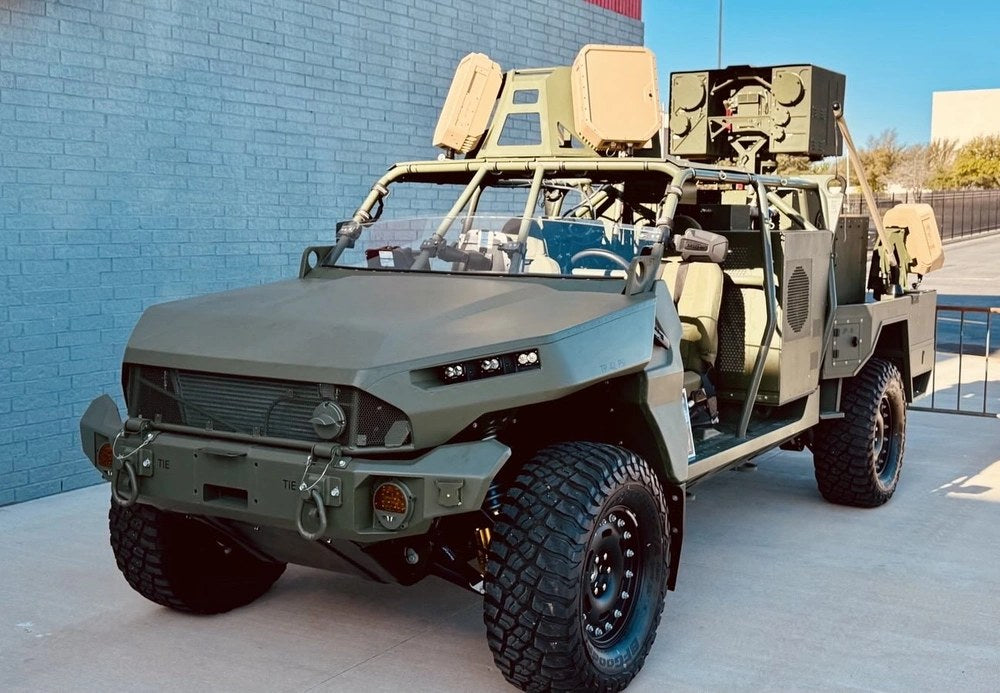
PHOTO CAPTION: A U.S. Army M1301 Infantry Squad Vehicle equipped with a LOCUST Laser Weapon System is displayed at Fort Sill, Oklahoma, in April 2025. The Army has now awarded a $464.8 million agreement to move the newer LOCUST X3 high-energy laser system into production. (U.S. Army photo by Venetia Gonzales)
Days after an Army laser was used to shoot down hostile drones operating along the southern border, the service has awarded a nearly $465 million deal to move high-energy counter-drone lasers from prototypes into production.
The Army announced Sept. 2 that AeroVironment received an agreement to produce systems for its Enduring-High Energy Laser program, or E-HEL. The service calls it the Army’s first production contract for a high-energy laser weapon system.
AeroVironment values the agreement at $464.8 million and says it will deliver dozens of its 30-kilowatt LOCUST X3 laser systems over the next several years. The weapons are intended to defend troops against Group 1 through Group 3 unmanned aircraft.
The production decision comes shortly after soldiers demonstrated what directed-energy weapons can do outside a test range.
During the late-night hours of Aug. 25 and 26, Joint Task Force-Southern Border personnel used an Army Multipurpose High Energy Laser, or AMP-HEL, to engage and defeat three hostile drones along the U.S.-Mexico border. The military said the aircraft were supporting activities that posed a physical threat to U.S. troops and Customs and Border Protection personnel.
Joint task force commander Maj. Gen. Curtis Taylor said cartel networks are increasingly using drones for smuggling and to conduct surveillance on U.S. military and law-enforcement personnel.
The laser used in those engagements was an AMP-HEL prototype rather than the new LOCUST X3 production model. But the Army says the E-HEL program builds on the experience gained with AMP-HEL systems already in service, moving directed-energy weapons from prototype development toward routine fielding.
The attraction is partly economic. Traditional air-defense missiles can cost hundreds of thousands or even millions of dollars each, while a high-energy laser draws primarily from its power supply and can repeatedly engage targets without carrying a magazine full of physical interceptors.
The Army describes E-HEL as having a low cost per shot and a “magazine” that essentially regenerates as long as the system can continue producing electrical power. That could make lasers particularly useful against swarms of relatively inexpensive drones.
AeroVironment says LOCUST X3 can engage smaller Group 1 and Group 2 drones as well as larger Group 3 aircraft. Company officials have described the system as a way to thin out drone threats while preserving conventional missiles and other interceptors for targets that require them.
The system also isn't being designed around a single vehicle.
LOCUST X3 can be integrated onto platforms including the Army’s Joint Light Tactical Vehicle, while the company and Army are examining integration aboard the Infantry Squad Vehicle. The Army says the broader E-HEL architecture can also operate from fixed installations, semi-fixed tactical positions and mobile combat vehicles.
That flexibility is intended to let commanders move laser defenses wherever drone threats emerge instead of permanently tying the capability to one vehicle or installation.
For years, military laser weapons largely remained experimental systems demonstrated at ranges and technology events. The Army’s new production agreement represents a much different stage: buying dozens of weapons intended for operational forces.
And that transition comes just days after soldiers used one of the Army’s prototype high-energy lasers against actual hostile drones on the southern border.
Sources: U.S. Army; Joint Task Force-Southern Border; AeroVironment
(Source: OAF Nation)