ARMY BASIC TRAINING EVOLVES BY 2026
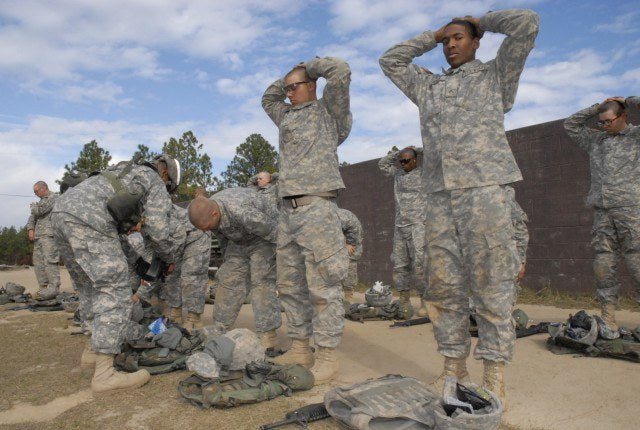
PHOTO CAPTION: Soldiers with Company C, 2nd Battalion, 13th Infantry Regiment take part in Victory Forge at Fort Jackson, South Carolina, in December 2007. (U.S. Army)
Ask Soldiers from different generations about basic training and the conversation usually gets competitive pretty quickly.
But Army records from Fort Jackson provide an unusually good way to compare the experience. The Army documented one company moving through Basic Combat Training there in 2007 in considerable detail, while current Fort Jackson material lays out what trainees are expected to complete in 2026.
The result isn't quite the simple “they have it easy now” story some veterans might expect.
In 2007, Soldiers with Company C, 2nd Battalion, 13th Infantry Regiment went through nine weeks of Basic Combat Training at Fort Jackson. Army reporting followed the roughly 140 trainees from their arrival through graduation.
Their training was heavily shaped by the wars in Iraq and Afghanistan.
During a three-day field exercise, the company made a five-mile road march before training in an urban environment, clearing rooms and reacting to simulated direct and indirect fire. They later trained with weapons including the M2 .50-caliber machine gun, M240B, M249, AT4 and hand grenades, along with buddy-team movements and mounted convoy operations.
Fort Jackson even constructed mock Iraqi neighborhoods for trainees. Army reporting from 2007 describes recruits clearing buildings while other Soldiers played insurgents, and Fort Jackson deliberately placed simulated improvised explosive devices around training areas because IEDs had become such a major threat in Iraq and Afghanistan.
The final test was Victory Forge, a seven-day field training exercise.
For the company the Army followed in December 2007, Victory Forge began with an 11-mile road march and included Battle March and Shoot, mounted combat patrols, night live fire and urban operations. The Army described scenarios that could begin with trainees negotiating with a simulated village leader before suddenly becoming a tactical assault.
Nearly two decades later, Fort Jackson Basic Combat Training lasts 10 weeks instead of nine.
A Fort Jackson graduation program dated Sept. 3, 2026 says today's trainees still move through Red, White and Blue phases while learning marksmanship, hand-grenade employment, buddy-team movement, medical and communications skills and chemical, biological and nuclear survival.
The culminating event is now called The Forge.
And the numbers make it difficult to dismiss the modern version as easy.
Fort Jackson's September 2026 graduation program says trainees foot-march approximately 45 miles over 81 hours, with training missions conducted mostly at night and under heavy load. According to the Army, trainees get about five hours of sleep on the ground during the day before returning to events that can include medical drills, pugil sticks and hand-to-hand fighting.
That does not mean today's Forge is automatically harder than the weeklong Victory Forge of 2007.
The Army's 2007 account gives an 11-mile distance for the opening march but does not provide a comparable total mileage for the entire seven-day exercise. Saying today's trainees march 45 miles while the 2007 group marched only 11 would therefore be misleading.
What can be said is that the structure changed significantly.
Current Fort Jackson guidance says trainees spend 10 weeks conducting physical training, walking dozens of miles while carrying up to 35 pounds of equipment, learning land navigation and medical care, qualifying with rifles, throwing grenades, moving under live machine-gun fire, completing obstacle courses and rappelling from a 40-foot tower.
The Army was already arguing about whether basic training had become “soft” more than 15 years ago.
In 2010, when BCT permanently expanded from nine to 10 weeks, Army Training and Doctrine Command publicly insisted the new program was becoming more challenging, not less. Rifle marksmanship was expanded, required combatives instruction doubled to 22 hours, and physical training was redesigned around battlefield demands and injury prevention.
At the same time, some old-school elements disappeared. The traditional bayonet assault course, for example, was removed while the Army increased pugil-stick and combatives training instead.
There is another interesting piece of evidence buried in the Army's 2007 reporting: even recruits back then didn't universally describe their experience as nonstop misery.
One trainee told the Army during her fourth week, “It is not as difficult as I thought it would be.” She had expected constant yelling but said the drill sergeants were more respectful than she anticipated.
Another Soldier, interviewed after graduation, said the first three weeks had been physically difficult but that the remainder felt easier by comparison.
Those are only two Soldiers from one training cycle, so they don't settle anything. But they do show that complaints about the next generation having an easier basic training aren't exactly new.
What changed most may be what the Army was preparing recruits to face.
In 2007, Fort Jackson was building training around the realities of Iraq and Afghanistan: IEDs, convoys, insurgents and urban fighting. Today's program still demands fieldcraft, weapons proficiency and physical endurance, but it exists in an Army preparing for a different battlefield.
So was Army basic training harder in 2007?
The Army's own records don't give a clean answer.
The 2007 course was shorter overall but ended with a seven-day Victory Forge and trained recruits specifically around the demands of two ongoing wars. Today's course lasts an additional week, and its culminating Forge compresses roughly 45 miles of movement and missions into 81 hours.
Maybe the most accurate answer is the one veterans probably won't agree on:
Basic training didn't simply get easier. It changed.
And now the argument belongs to the people who actually went through it.
What year did you attend Army basic training, where did you go, and what would today's trainees have the hardest time dealing with from your cycle?
(Source: OAF Nation)