Arlington Arch Faces Opposition
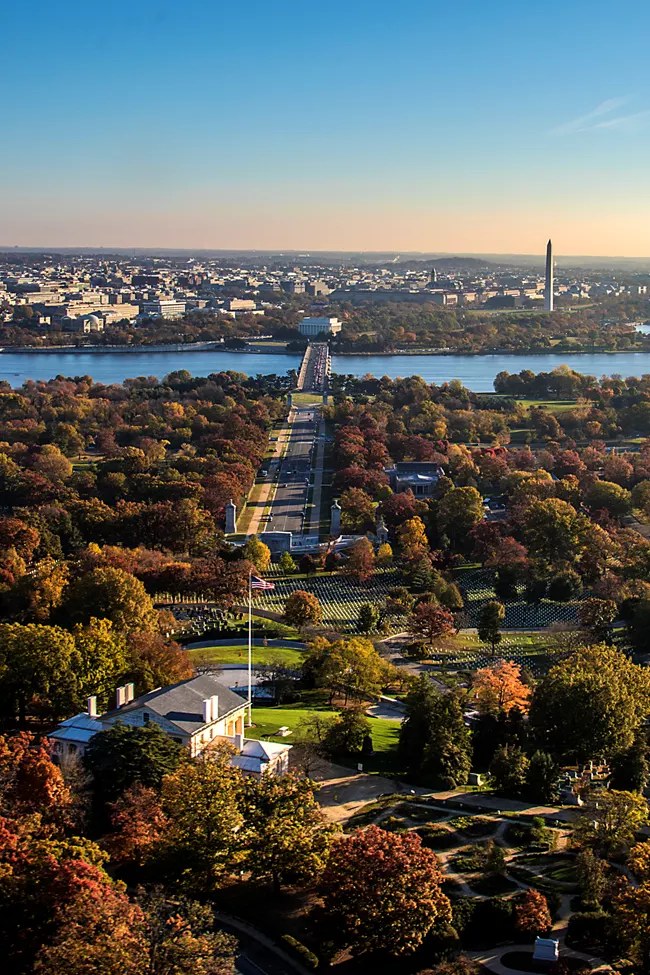
PHOTO CAPTION: Arlington National Cemetery and Memorial Avenue are seen looking toward Arlington Memorial Bridge and Washington, D.C. A proposed 250-foot triumphal arch would be built near the western end of the bridge. (National Park Service photo)
Veterans and preservation advocates are pushing back against plans for a massive triumphal arch near Arlington National Cemetery, with one Gold Star mother raising concerns that visitors on its observation deck could look toward military funerals.
The latest opposition campaign was launched Sept. 8 by several advocacy organizations challenging the proposed United States Triumphal Arch at Memorial Circle, between Arlington Memorial Bridge and the ceremonial approach to Arlington National Cemetery.
Karen Meredith, whose son Army 1st Lt. Ken Ballard was killed in Iraq and is buried at Arlington, said she is particularly concerned about plans for the observation deck.
“We don’t need tourists overlooking funerals,” Meredith said in a video released by opponents of the project.
Official National Park Service planning documents confirm that the proposed arch would rise approximately 250 feet, including its statuary.
The structure would contain five levels and roughly 70,000 square feet of interior space. Plans call for an exterior observation deck covering approximately 9,812 square feet at 161 feet, 6 inches above ground level.
The National Park Service says the arch is intended to commemorate the nation’s 250th anniversary and honor American founding principles, valor, sacrifice and national heritage. It would stand at Memorial Circle, which links Arlington Memorial Bridge with Memorial Avenue and the gateway to Arlington National Cemetery.
Opponents argue that its size, location and visitor facilities could fundamentally alter the ceremonial setting surrounding Arlington.
The project would also be a major construction undertaking. NPS documents estimate construction would take approximately two to three years, with work occurring in two 10-hour shifts — 20 hours per day, year-round — during the construction period.
The National Park Service’s revised historic-preservation assessment concluded that the project would have an adverse effect on one or more historic properties. A separate environmental review found no significant environmental impact, although the agency notes that finding does not itself constitute final approval of the project.
The proposal is also being challenged in federal court by opponents questioning the government's authority to construct the arch without additional congressional approval.
The debate now puts two different ideas of commemoration against one another: creating a new monument intended to honor the country’s history and military sacrifice while preserving the character and privacy of one of America’s most significant military burial grounds.
Sources: National Park Service; Military Times
(Source: OAF Nation)