Air Guard Medics Train on Cadavers
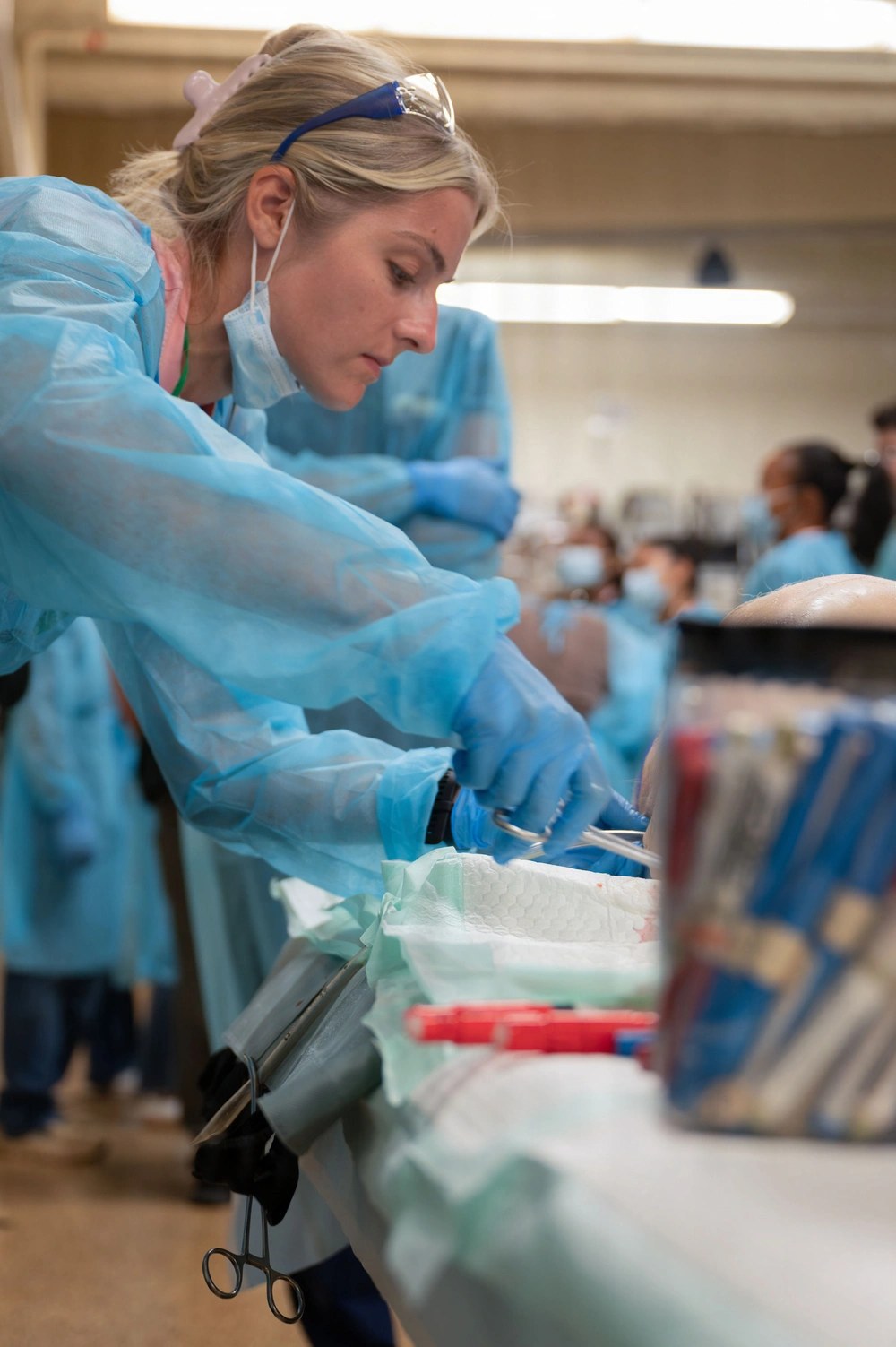
PHOTO CAPTION: U.S. Air National Guard 1st Lt. Kathrine Carlin prepares to insert a chest tube into a training specimen during Armed Forces Advanced Trauma Training at Marine Corps Base Hawaii on Aug. 20, 2026. U.S. Air National Guard photo by Staff Sgt. Alancea Grant.
Military medics training in Hawaii recently traded plastic mannequins for something dramatically more realistic: human cadavers used to recreate battlefield injuries and give medical personnel experience working with actual tissue.
Eleven members of the West Virginia Air National Guard's 130th Airlift Wing attended Armed Forces Advanced Trauma Training from Aug. 18–21, joining a 92-person class that also included other National Guard personnel and active-duty Navy and Marine Corps members. The training took place at Marine Corps Base Hawaii.
The program is designed to prepare military medical personnel for severe trauma in environments where mistakes can have immediate consequences. Students practiced procedures including chest tube placement, surgical airways, suturing, advanced airway management, ultrasound and other emergency interventions.
Instead of relying exclusively on medical mannequins, portions of the course used human cadavers and anatomical training specimens to recreate traumatic injuries.
A Global Training Institute spokesman compared the approach to other forms of military training, arguing that medics need experience with actual tissue for the same reason pilots and shooters train on real equipment. Mannequins, he said, cannot reproduce the same tactile response that medical personnel encounter when performing procedures on human tissue.
Staff Sgt. Tavia Dunham, a medical technician with the 130th Airlift Wing, described the experience as working on “fresh-frozen cadavers with blood flow” and said the training was about as realistic as medical personnel could get before entering the field.
The Air National Guard did not describe the specimens as living or suggest they contained naturally circulating blood. Its public account simply described the training cadavers as having blood flow while emphasizing the increased realism compared with plastic training aids.
Airman 1st Class Aaliyah Durigan, a respiratory therapist, said the course also allowed her to repeatedly practice procedures that normally fall outside her standard scope, including chest tubes, cricothyroidotomies and suturing. The repetition and access to experienced instructors were intended to help personnel perform those skills under pressure.
For the 130th Airlift Wing personnel involved, the training isn't limited to preparing for overseas combat. Their CBRNE Enhanced Response Force Package, known as CERF-P, can be called to domestic emergencies and mass-casualty events and has supported major National Capital Region security events such as presidential inaugurations and State of the Union addresses.
The Air National Guard also released more than seven minutes of public-domain footage from the course Wednesday. The video carries a graphic-content warning and shows students performing invasive medical procedures on human cadavers and anatomical specimens.
For Dunham, the realism is the point: give military medical personnel the experience before the day when the person in front of them is no longer a training specimen.
Source: U.S. Air National Guard / 130th Airlift Wing / DVIDS