Air Force Major in Solitary Confinement
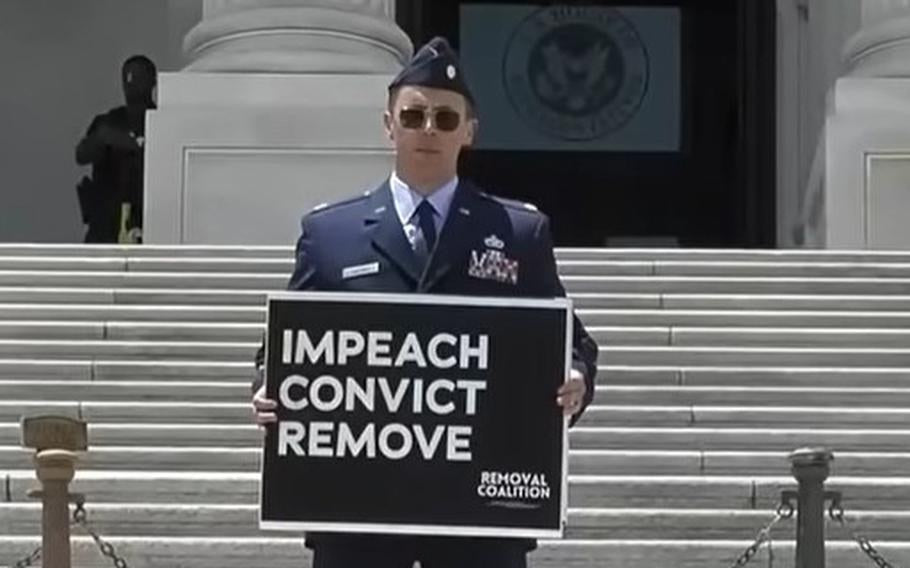
PHOTO CAPTION: Air Force Maj. Jason Watson stands on the U.S. Capitol steps holding a sign calling for the impeachment, conviction and removal of President Donald Trump and Vice President JD Vance on July 1, 2026. His attorney said October 9 that Watson remains in solitary pretrial confinement. Photo by Matthew Wagner, courtesy of the Removal Coalition, subject to reuse permission.
An active-duty Air Force major who publicly called for President Donald Trump's impeachment remains in solitary confinement nearly two months after being jailed while awaiting military court proceedings, according to his attorney.
Maj. Jason Watson, 40, has served approximately 17 years in the Air Force and has been held in pretrial confinement since August 18.
His civilian attorney, Christopher Mutimer, said Watson continues to be isolated around the clock at a civilian detention facility in Maryland.
"He's still in solitary confinement 24 hours a day," Mutimer told CNN on October 9, according to an October 12 Military.com report.
Mutimer said that even when Watson is permitted to leave his cell to eat or exercise, he does so alone.
Watson has not been convicted of the military offenses against him.
The case began attracting national attention on July 1, when Watson appeared in his Air Force service uniform on the steps of the U.S. Capitol.
Holding a sign reading "Impeach Convict Remove," he called for Trump and Vice President JD Vance to be impeached, convicted and removed from office.
Capitol Police arrested Watson after he continued demonstrating on the House steps without a member of Congress accompanying him.
The Air Force subsequently launched an investigation into his conduct.
Watson also made public statements criticizing the administration in interviews and other communications.
Military prosecutors charged him with 10 specifications under three articles of the Uniform Code of Military Justice.
Those include Article 88, which prohibits commissioned officers from using contemptuous words against the president and certain other senior government officials.
Other allegations involve disobeying orders or regulations and conduct unbecoming an officer.
The case is not limited to Watson's Capitol protest. Several charges concern other public statements and alleged failures to follow military instructions.
Following a September 18 preliminary hearing, a military hearing officer recommended that seven specifications proceed to a general court-martial, the military's highest trial level, while recommending dismissal of three others.
Those recommendations do not establish guilt and are not themselves a final court-martial referral.
Watson's defense has argued that criticizing political leaders does not automatically constitute contempt under military law.
The Air Force has maintained that service members, particularly commissioned officers, are subject to restrictions on political activity and public statements that do not apply to ordinary civilians.
Watson was ordered into pretrial confinement on August 18, one day after appearing in a CNN interview in which he again criticized the administration.
At the time, the Air Force cited probable cause involving allegations of continued misconduct.
The conditions of that confinement have since become another disputed issue.
During Watson's September preliminary hearing, his defense attorney raised concerns about his isolation.
The hearing officer said restrictions on housing Watson with civilian detainees contributed to the arrangement that placed him in solitary confinement.
Under Article 13 of the Uniform Code of Military Justice, pretrial confinement cannot be imposed as punishment or be more restrictive than circumstances require.
However, the fact that Watson is being held separately does not by itself establish that the law has been violated.
Military.com reported that neither the Air Force nor Watson's attorney responded to its requests for additional comment on the confinement conditions.
Watson's defense has also compared his treatment with that of former Marine Lt. Col. Stuart Scheller, who publicly criticized senior military leaders over the 2021 Afghanistan withdrawal.
Scheller spent nine days in pretrial confinement before his case concluded with a reprimand and forfeiture of pay.
Watson's attorneys argue that the significant difference in confinement raises questions about consistency in the military justice system.
The cases involved different circumstances, and the comparison does not establish that Watson's detention is unlawful.
For now, Watson remains accused, not convicted.
Nearly two months after being placed in custody, his attorney says he is still spending essentially all his time alone while his military case proceeds.
(Source: OAF Nation)