Air Force Addresses Spouse Contact Issues
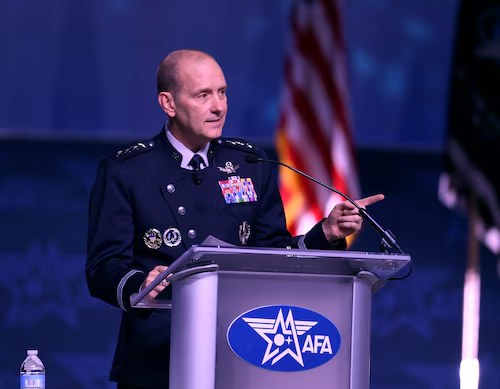
PHOTO CAPTION: Chief of Space Operations Gen. Douglas Schiess speaks during the Air, Space & Cyber Conference in National Harbor, Maryland, Sept. 15, 2026. Schiess later described an incident in which officials were unable to reach the wife of an airman who had died because the spouse contact number on file belonged to the airman himself. (U.S. Air Force photo by Andy Morataya)
The Air Force is launching a renewed effort to make sure military units have accurate contact information for spouses after senior leaders described cases in which commands struggled to reach families during some of the moments they needed support most.
One example was particularly stark.
Chief of Space Operations Gen. Douglas Schiess said he and his wife, Debbie, once needed to contact the wife of an airman who had died in Syria.
They called the number the service had on file.
It rang and rang.
The number belonged to the dead airman himself.
Schiess recounted the incident Wednesday during a military-family forum at the Air & Space Forces Association's annual Air, Space & Cyber Conference in Maryland.
According to Schiess, the airman apparently had not wanted his wife's telephone number entered into the system.
The episode illustrated a larger problem Air Force leaders say has persisted for years: the service can have personnel-accountability information on an airman while still lacking reliable contact information for the spouse who may need to hear from the command during a deployment, emergency or death.
The information is maintained through the Air Force Personnel Accountability and Assessment System, or AFPAAS.
Now the Air Force is trying to close that gap.
The service has begun distributing cards to unit leaders explaining how personnel lists can be pulled from AFPAAS and turned into updated recall rosters for Key Support Liaisons, the volunteers who help connect military units with their families.
The effort calls for units to identify the information they need, collect accurate family contact information, maintain an updated roster and regularly provide it to the appropriate liaison.
Cindy Wilsbach, wife of Air Force Chief of Staff Gen. Ken Wilsbach, said the problem became especially apparent after U.S. military operations against Iran began in February.
She said she heard from spouses around the world whose husband or wife had deployed but who had received no contact from anyone in the unit.
It was not an isolated complaint, she said.
“It wasn’t just one or two people. I heard it from a lot of people.”
Wilsbach said Key Support Liaisons have been asked to maintain connections with military families but cannot do that effectively when the service has not provided them with usable contact information.
The Key Support Program is designed to maintain communication between commands and military families, particularly during deployments and other periods when service members are away.
The contact lists involved contain personal information and are subject to privacy protections, but Air Force leaders said the current system can only work when service members provide accurate information in the first place.
Schiess urged troops not to prevent their spouses from being reachable through the system.
The Air Force's initiative does not appear to be a wholesale replacement of AFPAAS. Rather, leaders are trying to improve how units collect, maintain and distribute the contact information already available so the people tasked with supporting families can actually reach them.
Chief Master Sergeant of the Space Force John Bentivegna said leaders also have a responsibility to make the first move rather than waiting for spouses to seek help.
For military families, the consequences can extend well beyond routine command announcements.
Air Force casualty programs are responsible for providing notification, assistance and continuing support to families after the death of an airman or Guardian. The service also operates Air Force Families Forever to provide long-term support for eligible surviving family members.
The new contact-information push is intended to make sure those connections exist before the moment they are urgently needed.
(Source: OAF Nation)