Article: 53% of Troops Cite Politics in Exit Plans
53% of Troops Cite Politics in Exit Plans
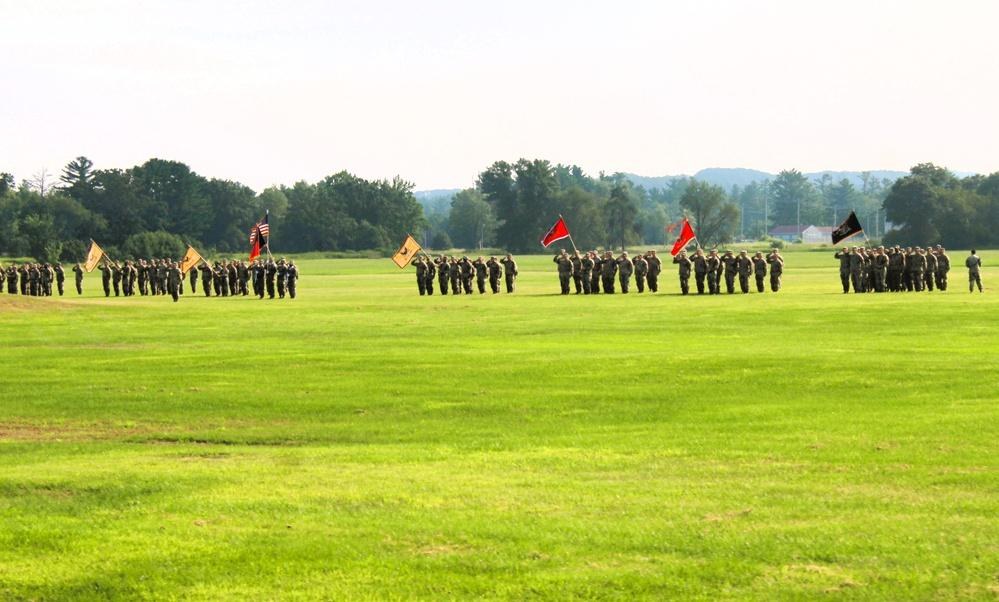
PHOTO CAPTION: U.S. Army soldiers stand in formation before a change of command ceremony at Fort McCoy, Wisconsin, on May 20, 2026. A recent survey found that 53% of its active-duty respondents said increasing military politicization made them want to leave service sooner. (U.S. Army photo by Staff Sgt. Avery Cunningham. Illustrative file photo.)
More than half of the active-duty service members surveyed in a recent military community poll said the increasing politicization of the armed forces makes them want to leave military service earlier than planned.
The finding comes from a survey commissioned by Common Defense, a veteran-led advocacy organization, and conducted by polling firm Change Research.
Among active-duty respondents, 53% said the military becoming more politicized made them want to separate sooner, while just 5% said it made them want to stay longer.
The results have drawn renewed attention following November 2 reporting about military attitudes toward President Donald Trump, Defense Secretary Pete Hegseth, and the direction of the armed forces.
But there is an important distinction: The survey does not establish that more than half of all active-duty troops want to leave the military.
What the Survey Actually Found
Change Research surveyed 731 people nationwide between September 15 and September 28, 2026.
The participants included active-duty military personnel, veterans, and immediate family members of service members.
Only 21% of those surveyed were currently serving on active duty, representing approximately 154 respondents.
The widely discussed 53% figure comes from that smaller active-duty group, not the entire sample and not a representative count of the U.S. military.
The survey also found that 26% of active-duty respondents said pay and benefits made them want to leave sooner.
The contrast suggests that political concerns were more frequently cited than compensation among the active-duty participants who answered the survey.
However, expressing a desire to leave earlier does not necessarily mean a service member has decided against reenlistment or taken steps to separate.
Concerns About Military Leadership
The broader survey found that 67% of respondents believed decisions affecting service members were being made for political gain rather than military readiness.
Approximately half disapproved of Trump's performance as commander in chief, while a similar percentage disapproved of Hegseth.
Among active-duty respondents specifically, 54% disapproved of Hegseth.
Congress received even lower ratings, with 74% of all respondents disapproving of its performance.
The findings indicate that dissatisfaction among participants was not limited to a single military official.
Common Defense Executive Director Jose Vasquez, an Army veteran, described the findings as a warning about military readiness and the possibility of experienced personnel leaving the force.
The organization argues that political considerations are increasingly influencing decisions that should prioritize military missions and personnel.
Common Defense is also a political advocacy organization with stated policy positions. Its interpretation of the survey reflects that perspective, while the underlying responses must be evaluated separately.
Iran War Raises Additional Questions
The poll also examined attitudes toward the ongoing U.S. military campaign against Iran.
According to the survey, 48% of active-duty respondents opposed Operation Epic Fury.
Across the broader military community sample, 55% supported congressional investigations into the length of deployments and the health, safety, and welfare of troops involved in the conflict.
Those findings come as American forces continue operating throughout the Middle East amid an extended confrontation with Iran.
Deployment demands, operational risk, and uncertainty about future military commitments can affect service members and their families.
The survey, however, does not establish how many respondents intend to leave because of the Iran war specifically, nor does it demonstrate that military deployments have caused an increase in actual separations.
Not All Findings Were Negative Toward Republicans
The survey's political breakdown adds context to its findings.
Republicans made up 47% of respondents, compared with 35% who identified as Democrats.
Nearly half of respondents, 47%, said the Republican Party does a better job communicating with the military, compared with 27% who selected Democrats.
Among Republican respondents, 63% nevertheless agreed that decisions affecting service members were being made for political gain.
This suggests that concern about military politicization was not confined to Democratic respondents.
The poll also found that 79% of respondents believed politicians and society were leaving veterans and military families behind.
That result points to broader dissatisfaction extending beyond individual political figures or specific military policies.
Does This Mean the Military Has a Retention Crisis?
Not necessarily.
The survey measures attitudes and stated intentions, not actual departures from military service.
It does not show that 53% of the armed forces have submitted separation paperwork or plan to refuse reenlistment when their contracts expire.
The active-duty portion of the sample was relatively small, and the poll's stated four-percentage-point margin of error applies to the overall survey. Results for smaller groups carry greater uncertainty.
Additionally, the survey was conducted online using a sample that was adjusted for demographic characteristics. It should not be treated as a definitive measure of opinion across the entire active-duty force.
Actual retention data, including reenlistment rates, separation figures, and personnel shortages, would be needed to determine whether these attitudes are translating into a measurable readiness problem.
The military's recent recruiting improvements also demonstrate that attitudes among existing personnel and the willingness of new recruits to enlist are separate questions.
A Familiar Debate for Veterans
Regardless of political affiliation, questions about leadership and retention have long been part of military life.
Service members routinely make decisions about staying or leaving based on deployments, family circumstances, leadership, career opportunities, pay, and their confidence in the institution.
The new survey adds political concerns to that discussion.
For military leaders, the key unanswered question is whether dissatisfaction among some service members will eventually affect reenlistments, experienced personnel retention, and unit stability.
For now, the poll provides a snapshot of concerns among a limited group of military personnel, veterans, and families.
It does not prove that the majority of America's active-duty force is preparing to leave.
But it does raise a question worth examining: How much do political decisions influence whether experienced service members choose to continue their military careers?
(Source: OAF Nation)